JoeyDDong.

JoeyDDong‘s Blog.

Writing code. Learning. Capturing life.

AtCoder Beginner Contest 363 Summary

本文是 AtCoder Beginner Conteset(ABC)363 的总结笔记。

A - Piling Up

Problem:A - Piling Up

省略

// Problem: https://atcoder.jp/contests/abc363/tasks/abc363_a

#include <bits/stdc++.h>
using namespace std;
typedef long long LL;
typedef pair<int, int> PII;

void solve() {
int n;
cin >> n;
if (n >= 200)
cout << 300 - n << endl;
else if (n >= 100)
cout << 200 - n << endl;
else
cout << 100 - n << endl;
}

int main() {
cin.tie(0);
ios_base::sync_with_stdio(false);
solve();
return 0;
}

B - Japanese Cursed Doll

Problem:B - Japanese Cursed Doll

省略。

// Problem: https://atcoder.jp/contests/abc363/tasks/abc363_b

#include <bits/stdc++.h>
using namespace std;
typedef long long LL;
typedef pair<int, int> PII;

const int N = 110;
int cnt[N];
int n, t, p;

void solve() {
cin >> n >> t >> p;
for (int i = 0; i < n; i++) {
int x;
cin >> x;
cnt[x]++;
}

for (int i = 1; i < N; i++)
cnt[i] += cnt[i - 1];

// 遍历长度
for (int len = 100; len >= 0; len--)
// 长度为 i 以上的人数达到了 p 人
if (cnt[100] - cnt[len - 1] >= p) {
cout << max(0, t - len) << endl;
break;
}
}

int main() {
cin.tie(0);
ios_base::sync_with_stdio(false);
solve();
return 0;
}

C - Avoid K Palindrome 2

Problem:C - Avoid K Palindrome 2

模拟题。

题目:

给定长度为 NN 的小写字母字符串 SS。求 SS 的排列数量,且其中不含长度为 KK 的回文串子串。

约束条件:

2≤K≤N≤102 \leq K \leq N \leq 10

思路:

按照题目要求进行模拟即可。

关键技术有两个:

  1. 如何求 SS 的全排列:使用 STL 的全排列函数 next_permutation 即可。并且 next_permutation 会自动去重。时间复杂度 O(n!)O(n!)。(注意,next_permutation 使用前要 sort,否则枚举会遗漏)
  2. 如何快速验证回文串:双指针左右向中间夹逼即可。时间复杂度 O(n2)O(\frac{n}{2})

整体时间复杂度最极端情况下是 O((n−k)n2n!)O((n-k)\frac{n}{2}n!),在本题的规模下大约是 1e8,在约束时间范围内。

// Problem: https://atcoder.jp/contests/abc363/tasks/abc363_c

#include <bits/stdc++.h>
using namespace std;
typedef long long LL;
typedef pair<int, int> PII;

int n, k;
string s;

// 快速判断回文
bool check(int l, int r) {
while (l < r)
if (s[l++] != s[r--])
return 0;
return 1;
}

void solve() {
cin >> n >> k;
cin >> s;
sort(s.begin(), s.end());

int res = 0;
int len = s.size();
do {
bool can = true;
for (int i = 0; i + k - 1 < len; i++) {
if (check(i, i + k - 1)) {
can = false;
break;
}
}
if (can)
res++;
} while (next_permutation(s.begin(), s.end()));
// 备注:next_permutation 在用的时候会自动去重

cout << res << endl;
}

int main() {
cin.tie(0);
ios_base::sync_with_stdio(false);
solve();
return 0;
}

D - Palindromic Number

Problem:D - Palindromic Number

题目:

形如 12211221 或者 1232112321 的数称为回文数。求第 NN 大的回文数。

约束条件:

1≤N≤10181 \leq N \leq 10^{18}

思路:

当对比数字大小的时候,有如下规律:

  1. 位数长的一定比位数短的数字大
  2. 相同长度下,高位数大的数字大

对于一个回文串数,后半部分是前半部分的镜像,所以我们可以暂时忽略后半部分,仅仅使用上面两条规则,就可以比较出回文串数字的大小。

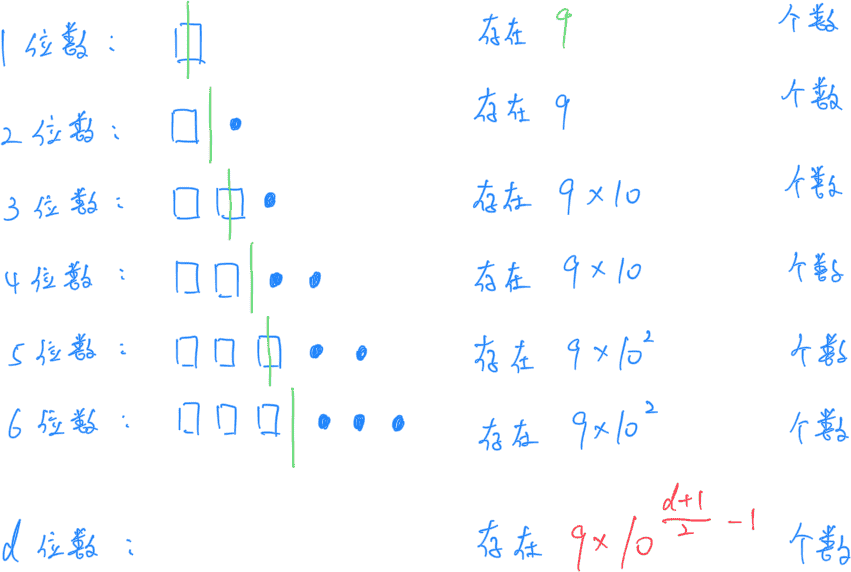
通过观察,实际可以发现有如下的关系。此时回文串数字的大小也是递增的。

image-20241213000406998

根据上面规则,想要求出第 NN 大的数:

先通过迭代,确定这个数的位数范围,求出前面位数累计下来的回文串数 N′N^\prime ;

然后直接根据 N−N′N-N^\prime 确定在当前位数下的偏移量,再回文镜像生成需要的数字即可。

这个数字会非常的大,但是能够看出来,回文串的前半部分肯定能被 long long 存下。

// Problem: https://atcoder.jp/contests/abc363/tasks/abc363_d

// 找第n大的回文数
#include <bits/stdc++.h>
using namespace std;
typedef long long LL;
typedef pair<int, int> PII;

LL N;

// 快速幂模板
LL qpow(LL a, LL b) {
LL res = 1;
while (b) {
if (b & 1)
res *= a;
a *= a;
b >>= 1;
}
return res;
}

void solve() {
cin >> N;

// 特判
if (N == 1) {
cout << 0 << endl;
return;
}

// 偏移量修正(把0给修正掉)
N--;

// 枚举回文串数字的位数
for (int d = 1;; d++) {
// 回文串数字对称轴左侧的位数
int x = (d + 1) / 2;

if (N <= 9 * qpow(10, x - 1)) {
string S = to_string(qpow(10, x - 1) + N - 1);
// 把S长度扩展为d,后面不足的位置用' '补充
S.resize(d, ' ');

// 把后面的空位补上
for (int i = x; i < d; i++)
S[i] = S[d - 1 - i];
cout << S << endl;
return;
} else {
N -= 9 * qpow(10, x - 1);
}
}
}

int main() {
cin.tie(0);
ios_base::sync_with_stdio(false);
solve();
return 0;
}

E - Sinking Land

Problem:E - Sinking Land

优先队列 BFS

题目:

给定一个 H×WH\times W 的网格,每个格点有高度值 Ai,jA_{i,j}。网格外侧被海洋环绕,海平面以每单位 1 的速度上升。

输出 1∼Y1\sim Y 时刻,没有被水淹没的格点的数量。

约束条件:

1≤H,W≤10001 \leq H, W \leq 1000

1≤Y≤1051 \leq Y \leq 10^5

1≤Ai,j≤1051 \leq A_{i,j} \leq 10^5

思路:

经典的优先队列 BFS 模型。

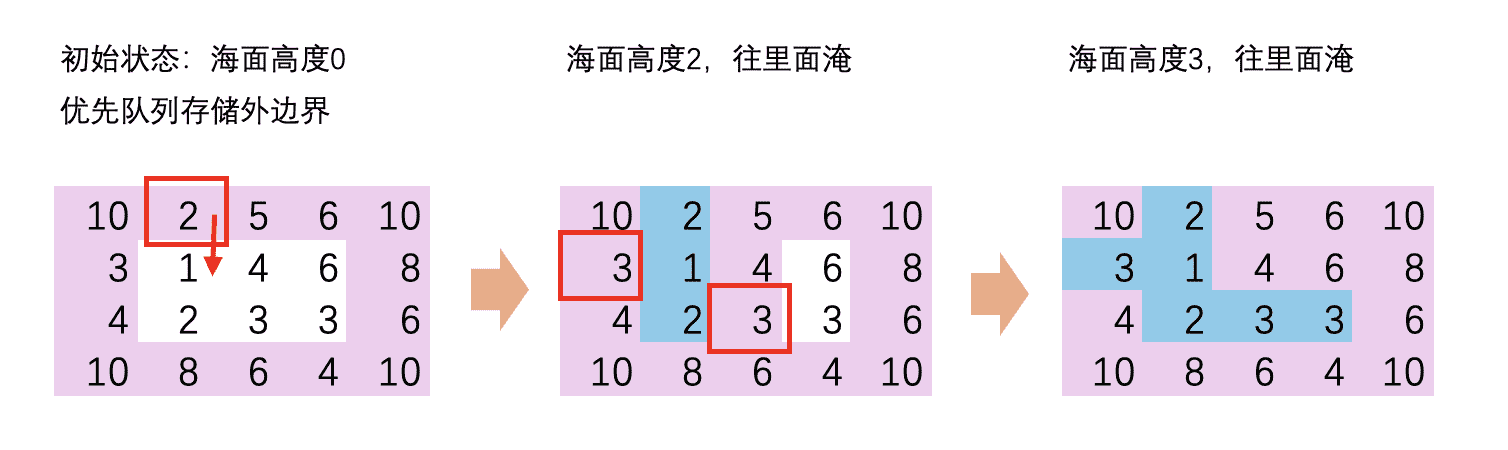
如下图所示。由于水肯定是从外边界往中心走。在初始化的时候,将所有外边界的点(粉色区域)都存入优先队列中。这里使用小根堆模型。

取出最小值,可知当海平面高度为 2 的时候,会从这里开始灌水。此时将 2 周围的点存入优先队列,挨个弹出,直到优先队列最小值大于 2.

再取出优先队列的最小值 3,说明海平面高度为 3 的时候,会开始灌水…….依次循环。

image-20241213003151333

所有的点都会进出一次优先队列,总时间复杂度为 O(HWlog⁡n)O(HW\log n)。(备注:log⁡n\log n 是小根堆提供的时间复杂度)

// Problem: https://atcoder.jp/contests/abc363/tasks/abc363_e

#include <bits/stdc++.h>
using namespace std;
typedef long long LL;
typedef pair<int, int> PII;

int dx[4] = {-1, 0, 1, 0}, dy[4] = {0, 1, 0, -1};
struct Node {
int x, y, t;
bool operator<(const Node& a) const { return t > a.t; }
};
priority_queue<Node> Q;
const int N = 1010;
int H, W, Y;
int A[N][N];
bool st[N][N];
int res[100010];

void solve() {
// 读入数据
cin >> H >> W >> Y;
for (int i = 1; i <= H; i++)
for (int j = 1; j <= W; j++)
cin >> A[i][j];

// 把边缘的格子加入小根堆
for (int i = 1; i <= H; i++)
for (int j = 1; j <= W; j++)
if (i == 1 || j == 1 || i == H || j == W) {
st[i][j] = true;
Q.push((Node){i, j, A[i][j]});
}

int T = 0;
while (Q.size()) {
// 拿出当前最低的格子
Node now = Q.top();
Q.pop();
int x = now.x, y = now.y, t = now.t;
T = max(T, t);
res[T]++; // T 高度被淹的格子数量+1

// 看一下这个格子周围的四个方向
for (int i = 0; i < 4; i++) {
int a = x + dx[i], b = y + dy[i];
// 越界
if (a < 1 || a > H || b < 1 || b > W)
continue;
// 已经在队列中
if (st[a][b])
continue;

// 入队
Q.push((Node){a, b, A[a][b]});
st[a][b] = true;
}
}

// 计算前缀和(已知i时刻淹了的格子数量,就知道0~i时刻总共被淹的格子数量)
for (int i = 1; i <= Y; i++)
res[i] += res[i - 1];
// 输出结果
for (int i = 1; i <= Y; i++)
cout << H * W - res[i] << endl;
}

int main() {
cin.tie(0);
ios_base::sync_with_stdio(false);
solve();
return 0;
}

F - Palindromic Expression

Problem:F - Palindromic Expression

DFS

题目:

给定一个整数 NN,输出一个满足下面条件的表达式 SS:

  1. SS 长度在 [1,1000][1,1000] 以内,只包含数字 1∼91\sim 9 和 乘号 *
  2. SS 是回文串,且第一个字符是数字
  3. 表达式 SS 的计算结果等于 NN

例如:363 可以拆成 11*3*11 或者直接输出 363

约束条件:

1≤N≤10121 \leq N \leq 10^{12}

思路:

使用 DFS 搜索。

对于一个数字 n,我们可以先判断能否拆成 x×n′×yx \times n^\prime \times y 的形式,并且 x 和 y 轴对称。然后再将 n′n^\prime 作为输入,再向下继续 DFS,直到把它拆成一个形如 121 样子的回文串数字。最后拼接即可。

// Problem: https://atcoder.jp/contests/abc363/tasks/abc363_f

// DFS
#include <bits/stdc++.h>
using namespace std;
typedef long long LL;
typedef pair<int, int> PII;

LL N;

string dfs(LL n) {
string s = to_string(n);
string s_rev = s;
reverse(s_rev.begin(), s_rev.end());
int len = s.size();
bool zero_flag = false;

// 遍历看中间有没有 0 出现(因为我们想要的数中不能有0)
for (int i = 0; i < len; i++)
if (s[i] == '0')
zero_flag = true;

// 如果没有 0 出现,并且是回文,直接返回
if (!zero_flag && s == s_rev)
return s;
for (int i = 2, l = sqrt(n); i <= l; i++) {
if (n % i == 0) {
bool flag = true;
int t = i, j = 0;
// 看看t里面是否有0(因为我们想要的数中不能有0)
while (t) {
if (t % 10 == 0)
flag = false;
t /= 10;
}
t = i;
// 中间出现 0 了,直接跳过
if (!flag)
continue;
// 算出计算和 i 对称的数 j
while (t)
j = j * 10 + t % 10, t /= 10;
// 如果找到了这一对对称的数,就继续往下面搜
if ((n / i) % j == 0) {
string ret = dfs(n / i / j);
// 如果得到的结果不是空串
if (ret != "")
return to_string(i) + "*" + ret + "*" + to_string(j);
}
}
}
return "";
}

void solve() {
cin >> N;
string ret = dfs(N);
if (ret != "")
cout << ret << endl;
else
cout << -1 << endl;
}

int main() {
cin.tie(0);
ios_base::sync_with_stdio(false);
solve();
return 0;
}
Programming#Algorithm#Programming Contest#AtCoder#ABC
Back to articles ←